Introduction
Cargo Bridge is a Blender add-on that imports your downloaded KitBash3D Cargo library directly from the Blender interface. Assets are indexed from Cargo's own SQLite manifest, sorted by kit, and shown in a fast thumbnail browser. Models, materials, textures and HDRIs can be imported without leaving the 3D Viewport or Shader Editor.
Disclaimer: Assets must be downloaded through the Cargo desktop app first. This add-on is a standalone browser and does not require the official Cargo Connector.
Note: The add-on does not download asset files from KitBash3D. It imports assets that already exist in your local Cargo library. Only preview images are fetched and cached from Cargo's public CDN.
Features
Workflow
How to use Cargo Bridge?
| Download the assets through the Cargo desktop app. |
Cargo stores kits in %APPDATA%\kitbash3d\kits on Windows, with the equivalent application data folder on macOS and Linux. |
Add the path in the add-on preferences under the Library tab. Either the kitbash3d folder or its kits folder works. |
| Open the Sidebar (N-Panel) and switch to the C-Bridge tab. |
| Pick a kit, search, and press Import. Materials and textures are also available in the Shader Editor, and HDRIs in the World shader editor. |
Grid View
Browse downloaded models, materials and HDRIs by kit.
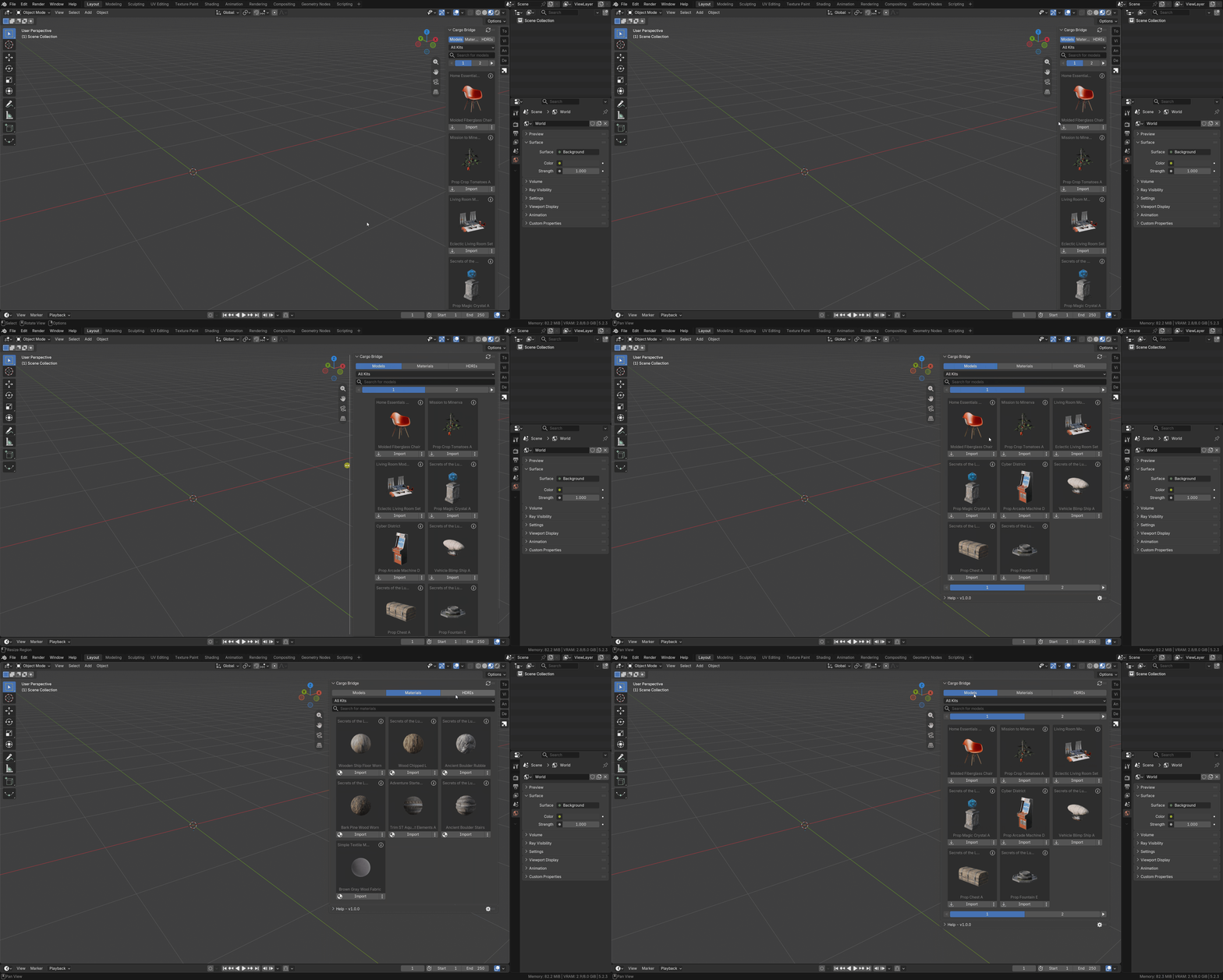
Cargo folder codes are converted to readable names, with the kit name shown above each thumbnail. Use the kit dropdown to narrow the grid, adjust thumbnail scale and page size in the preferences, and refresh the library from the panel header.
Asset Search
Search assets by name.
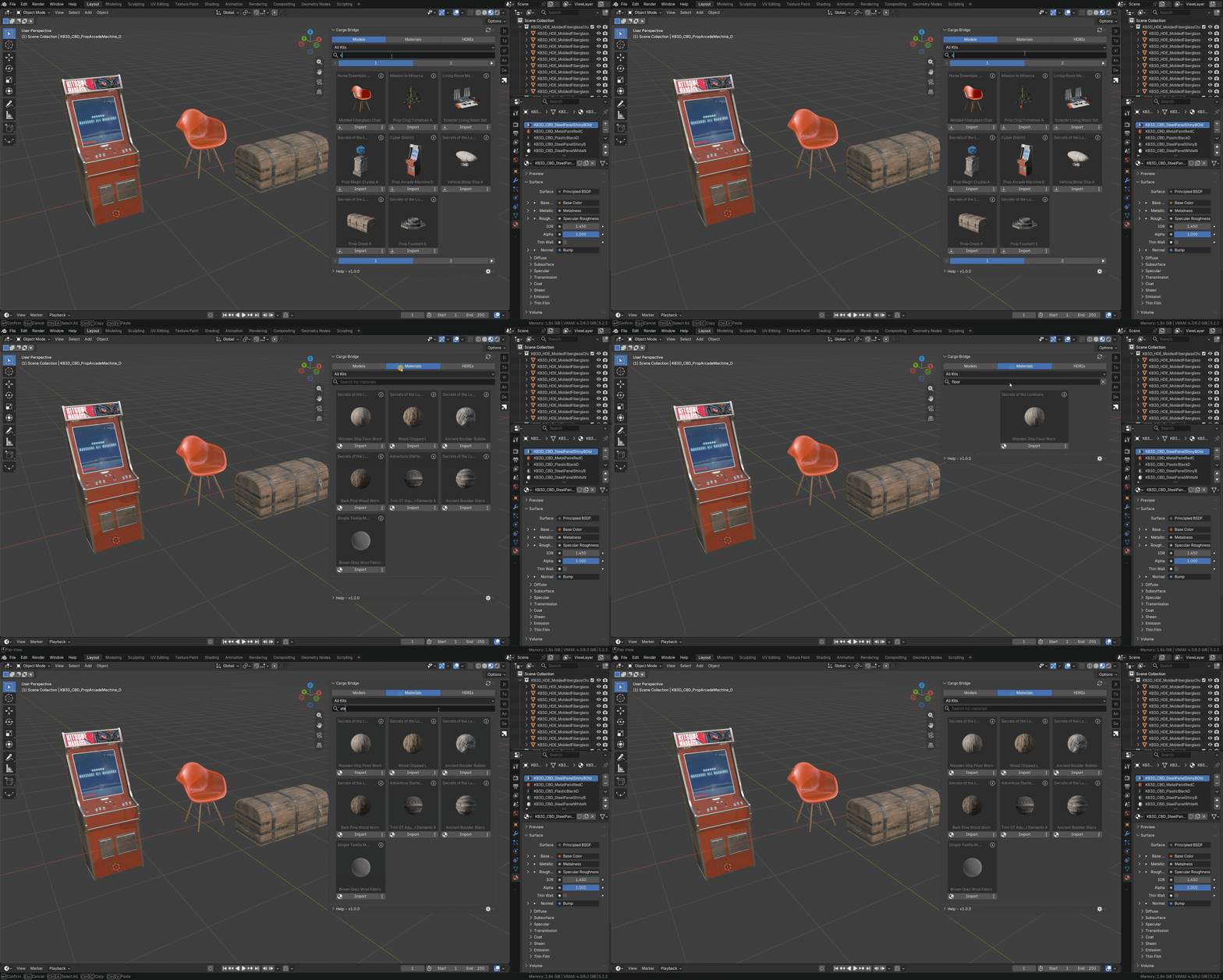
The search box filters the current asset type and resets pagination, so results stay focused while you browse a large library.
Asset Details
View previews, resolution, poly count, height, material count and texture size.
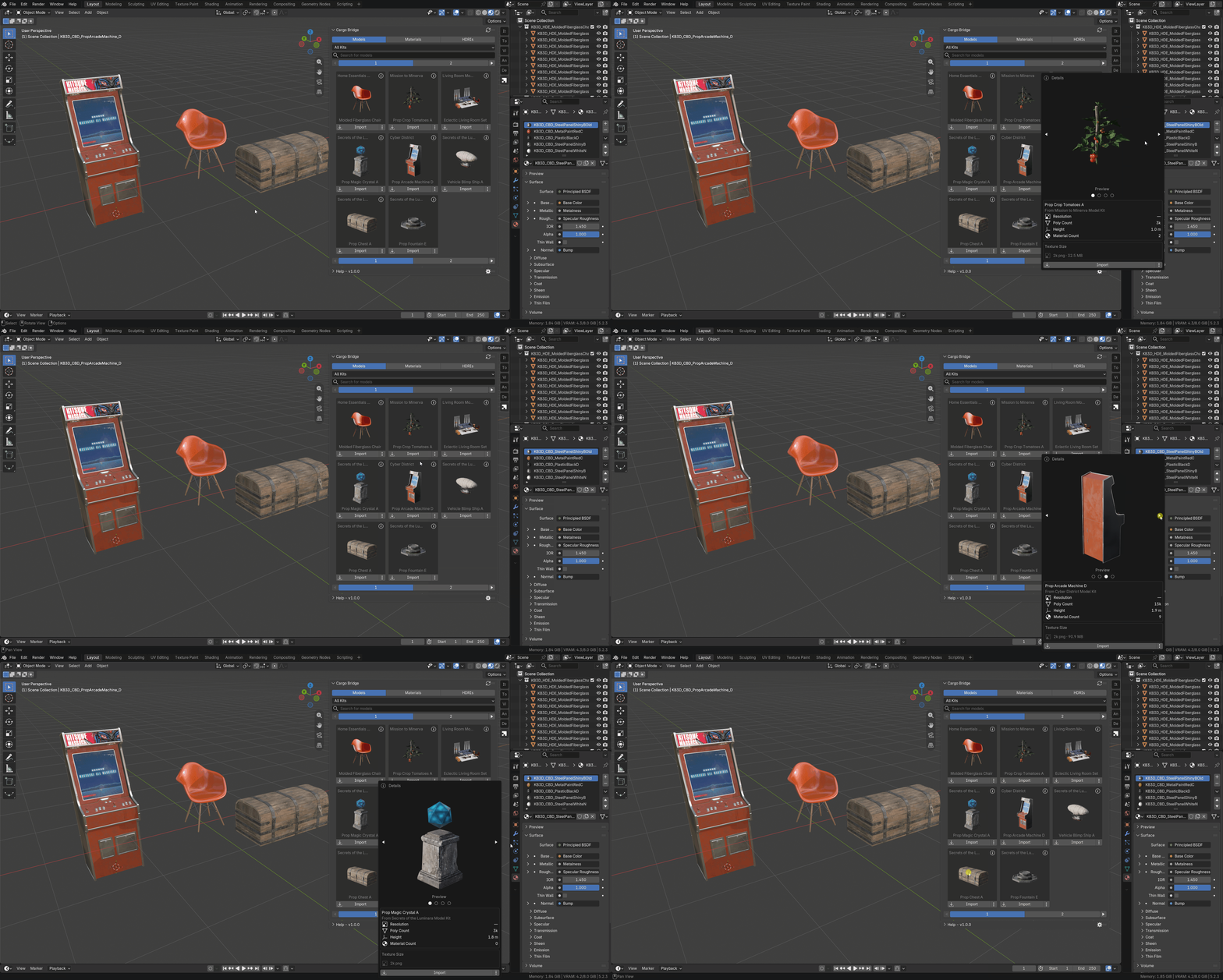
Open the info popup on a thumbnail for a preview gallery and asset details. Model views, material balls and HDRI composites are downloaded from Cargo's CDN and cached, so they only load once.
Pagination
Navigate through pages of assets.
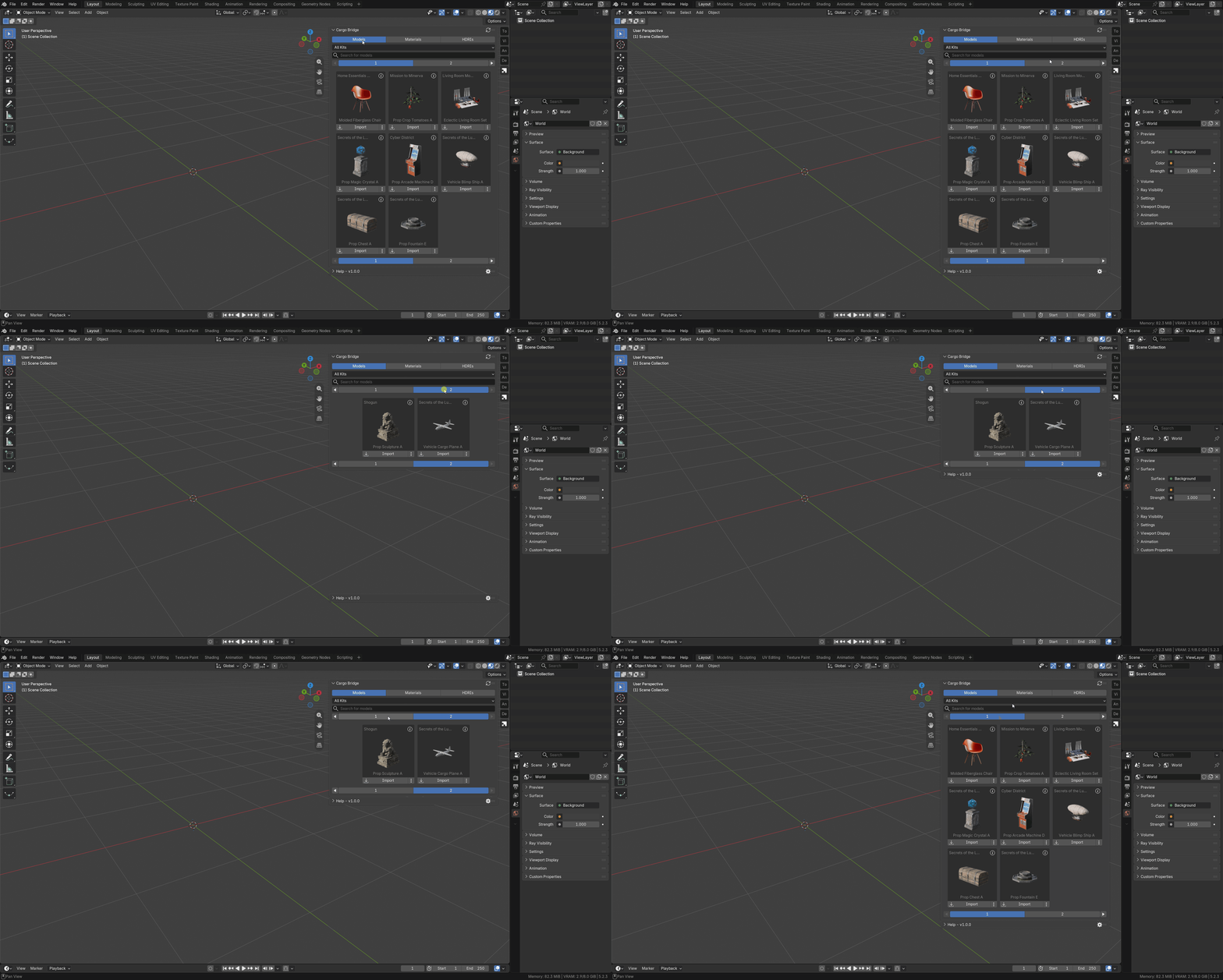
Move through pages with the arrows or page buttons. The number of assets per page is configurable in the preferences.
Import Models
Import models and assemblies with their Cargo materials rebuilt.
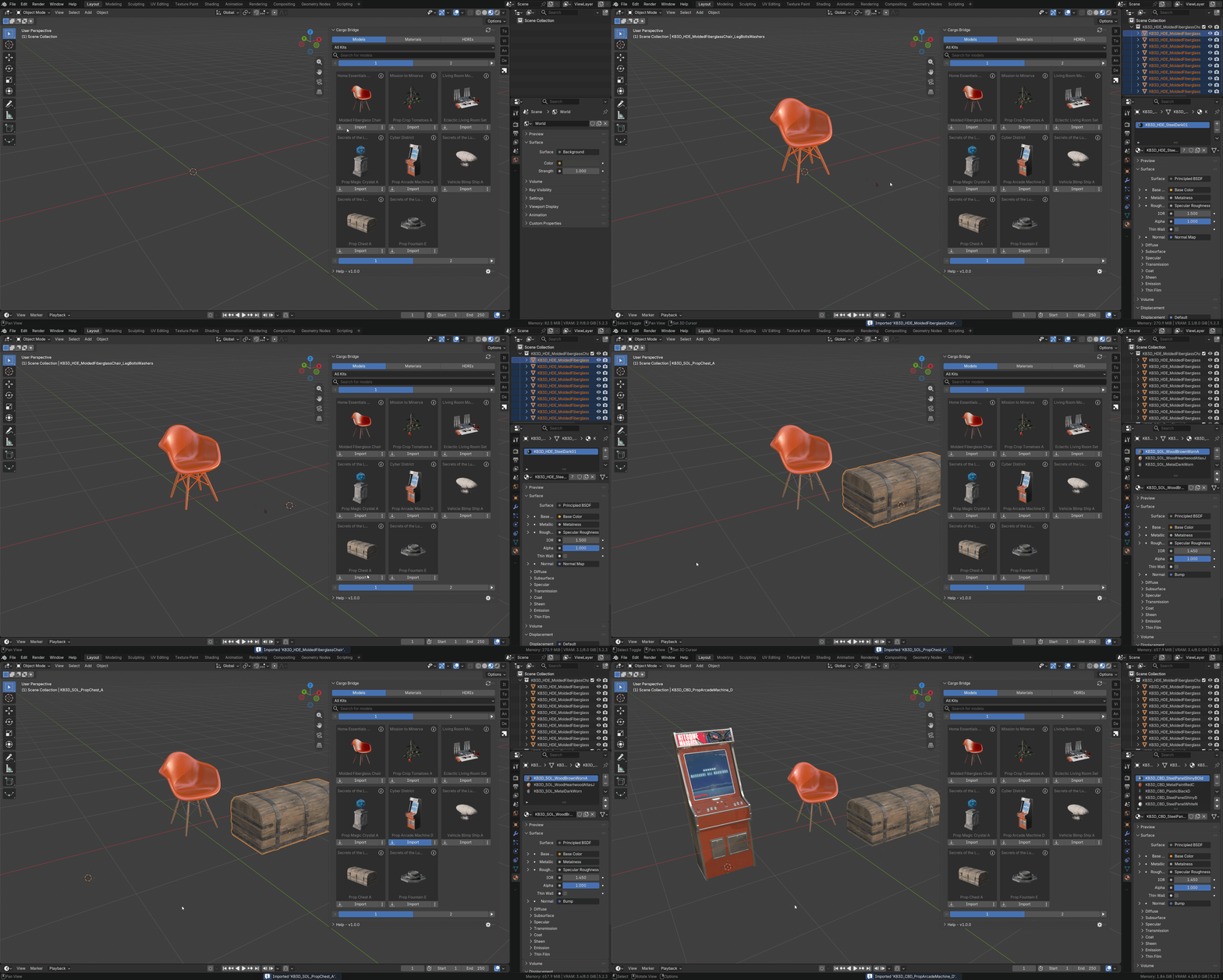
Geometry is imported with Blender's USD importer into a new collection at the 3D cursor. Cargo materials are rebuilt from their MaterialX graph, and colliders are imported hidden or removed depending on the options.
Enable Import as Collection Instance to keep the asset in a hidden source collection and place an instance at the 3D cursor. Re-importing a model already in the scene is blocked instead of creating a duplicate.
Import Materials
Build native Principled BSDF materials from Cargo MaterialX files.
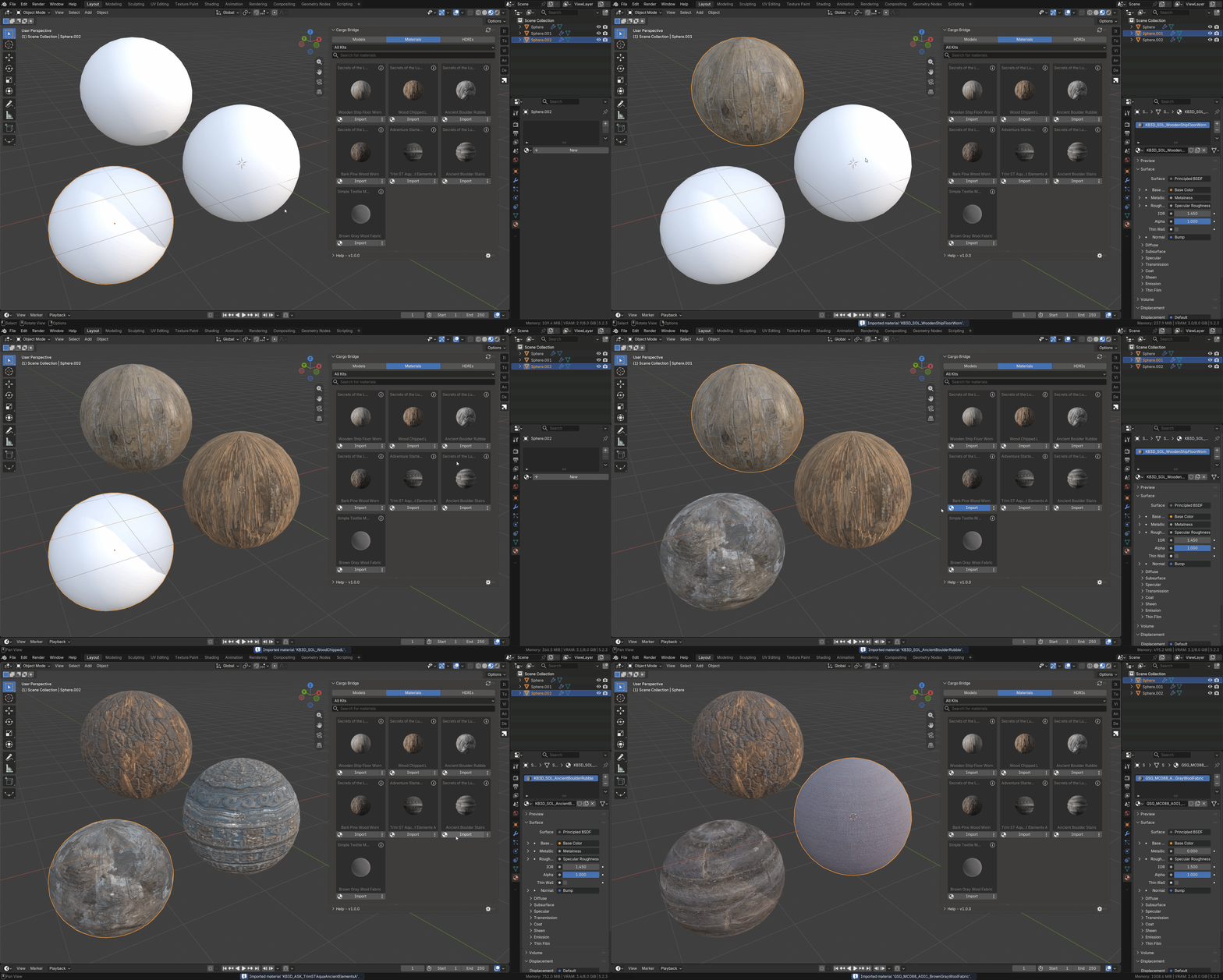
Materials are parsed with pxr and rebuilt as Principled BSDF node trees: base color, metalness, roughness, normal, height, emission, transmission, subsurface, coat and sheen. The resolution and format that were actually downloaded are selected automatically.
Use Apply Material to assign the material to the selected objects, or Mark as Asset for the Asset Browser. In the Shader Editor, a Cargo material can also be added as a reusable shader node group.
Import Textures
Add loose Cargo textures as image nodes or materials.
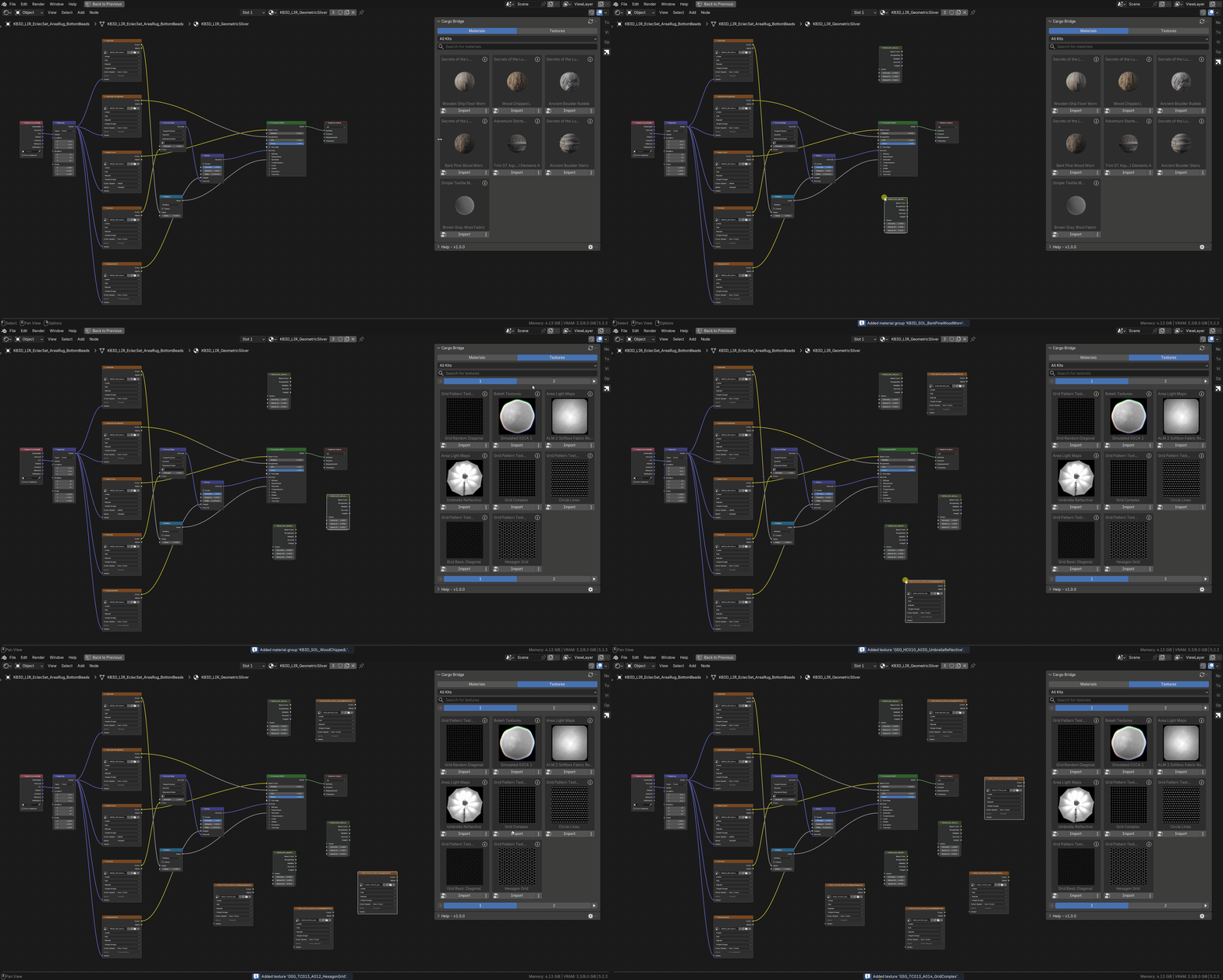
In the Shader Editor, switch to the Textures tab and add a texture as an Image Texture node, or import it as a material. Choose sRGB for color maps and Non-Color for masks, roughness and other data maps in the preferences.
Import HDRIs
Use Cargo HDRIs as the scene world or as environment nodes.
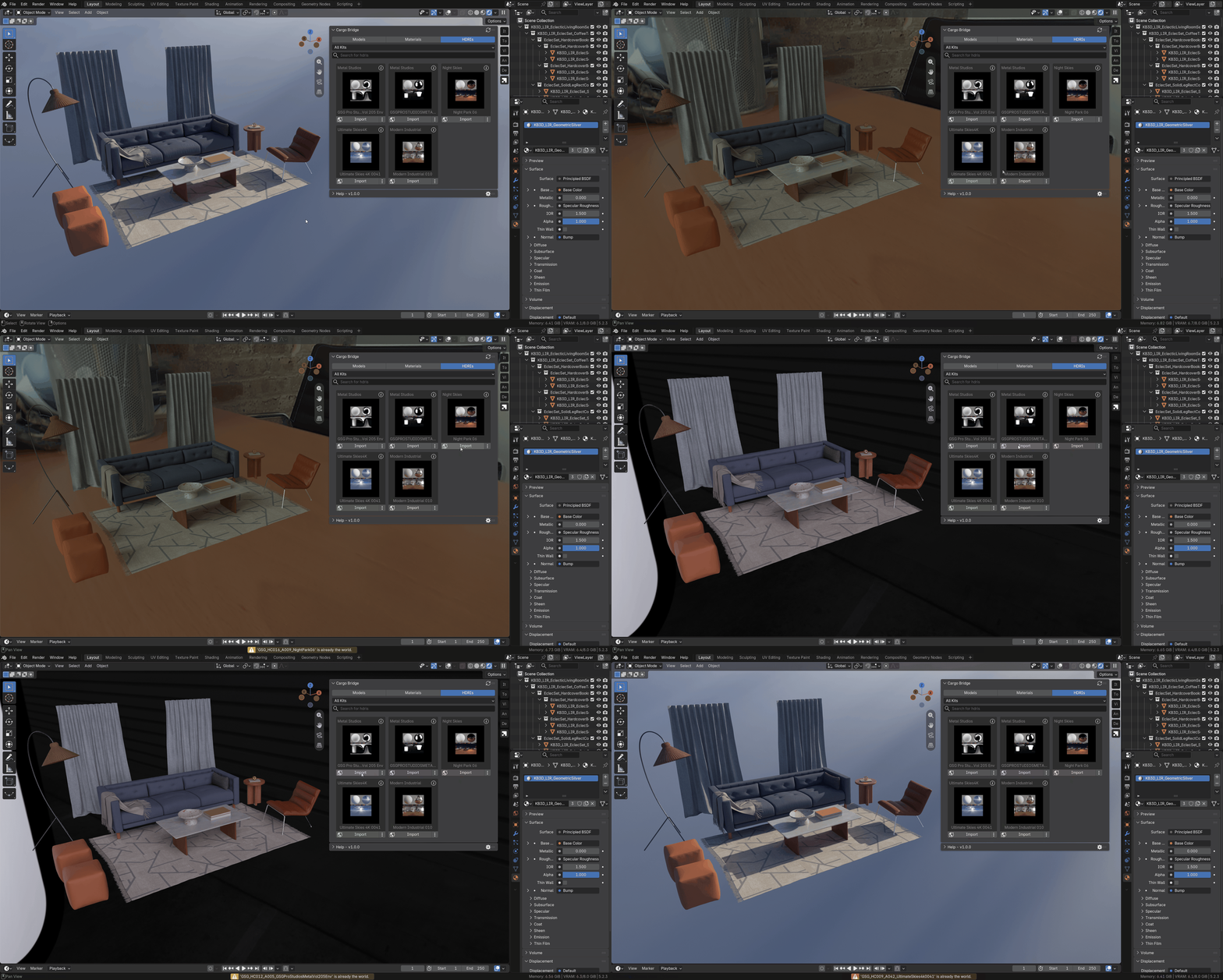
Select an HDRI in the 3D Viewport to set it as the scene world, or add it as an Environment Texture node in the World shader editor.
Preferences
Configure the library, import behavior and browser layout.
| Library | The Cargo library path and the optional Pillow dependency. |
| Model | Import Colliders and Import as Collection Instance. |
| Material | Skip Existing Materials, Use Gamma Node, Hide Texture Nodes, displacement method and scale, and copying textures beside the .blend file. |
| Texture | sRGB or Non-Color colorspace for standalone texture assets. |
| Preview | Sort order, assets per page, thumbnail scale, popup scale and showing asset names. |
Notes
Good to know before importing.
Cargo Connector is not required. This is a standalone browser. The official Cargo Connector can stay installed if you also use Cargo's "Send to Blender" button.
Only explicitly downloaded assets are listed. Model parts and dependency materials stay with their parent kit instead of appearing as separate cards.
Previews are cached in the platform user cache and downloaded in the background. If the CDN is unavailable or an asset has no preview, cards fall back to the base color, material color or raw HDRI.
Repeated sub-components use unique mesh data in this version; there is no custom USD mesh instancer.
Pillow is optional. Install it from the Library preferences for faster thumbnail scaling on large libraries.
Copyright Disclaimer
This add-on is an independent tool and is not affiliated with, authorized, sponsored, or otherwise approved by KitBash3D.
All Cargo assets and content remain the property of KitBash3D and are subject to their terms of use and licensing agreements.
KitBash3D and Cargo are trademarks or registered trademarks of KitBash3D in the USA and elsewhere.
Support
Join our Discord server to stay updated.
Other Add-ons
Other add-ons you might like.







Become an Affiliate
Interested in becoming an affiliate partner?
We are actively seeking individuals who are passionate about our products and are eager to spread the word. As an affiliate, you'll have the opportunity to earn a commission on sale that comes from your referrals. If this interests you, we'd love to hear from you. Please contact us on Discord to discuss this opportunity further. We look forward to the possibility of welcoming you to our affiliate program.
Discord DM: karan.b3dhub